The Rulebook
I. About the game
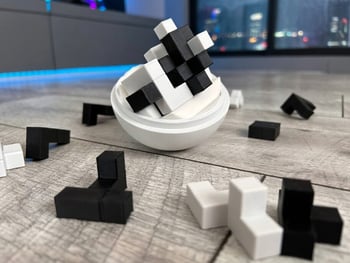
Equilibrium: Gravity Architect is a study in structural integrity and tactical pressure. Players act as rival Architects, navigating a "wobbling" landscape to construct a monument that defies the laws of physics. Every placement is a Gambit; every shift is a Counter-move.
II. Core Benefits
- Training Focus: A perfect "desk break" to reset your mind between meetings.
- 3D Modeling in Mind: Sharpen spatial reasoning for kids and adults alike.
- Hand-Eye Coordination: Translating a mental plan into a delicate physical placement.
- Dynamic Physics Experience: A hands-on lesson in center of mass and rotational inertia.
- Tactical Thinking: Planning your moves to trap your opponents in an unstable "Danger Zone".
- Emotional Calmness: Focusing on the "next step" acts as a form of active meditation.
- Social Bonding & Team Building: Collaborative modes foster communication and shared triumph as teams work together to solve the "puzzle" of an increasingly unstable tower.
III. Setup
- Choose Your Mode: Flip the Base Assembly to your desired difficulty:
- Vertical Mode (Planar Side): Great for beginners. Uses a "sunk cube" anchor for a stable start.
- Inclined Mode (Faceted Side): For experts. Uses a "sticking up" cube anchor to force angled, unstable foundations.
- Assign Colors: Each player or team chooses a set of elements, so all elements of one colour belong to one player.
- The Anchor: Place the first element into an anchor point to establish the foundation.
.jpg?width=350&height=313&name=image%20(1).jpg)
IV. The Balancing Challenge
Standard Competitive Rules:
- Vision: In Competitive Mode, players become rival Gravity Architects locked in a high-stakes duel against each other and the tower itself. Every placement is a calculated Gambit. Every shift is a ruthless Counter-move. The
goal is simple: outsmart your opponents, push the tower to its breaking point, and be the last Architect standing when it finally collapses. Only one can claim the title of Gravity Architect.
- The Turn: On your turn, select one element and place it on the tower using only one hand.
- The "No-Takeback" Rule: Once a player touches an element, they must use that element. No swapping!.
- Adjustment: You may use your placement hand to slightly nudge the tower with your current element, but beware of the wobble.
- Skip turn: Each player can skip one turn per round.
- Winning the Round: A round concludes when one of the following two conditions is met:
- The Blunder: The round ends immediately if a player's placement causes a "Structural Collapse." This is defined as three or more elements falling and making contact with the table surface.
- Note: Players may agree to adjust this "Collapse Threshold" before the game begins; however, 3 elements is the standard default.
- Forfeiture: The round ends if a player (or team) is unable or unwilling to make a legal move for a second time during the game.
- The Blunder: The round ends immediately if a player's placement causes a "Structural Collapse." This is defined as three or more elements falling and making contact with the table surface.
- Fallen elements: If elements fall but the "Collapse Threshold" (3 or more pieces) has not been reached, the game continues. In this event:
- Recovery: The player who caused the fall must collect all fallen polycubes.
- The Weight of Failure: These recovered polycubes remain in play and are added to that player’s personal reserve, increasing their “hand size.” They will be counted toward scoring at the end of the round.
- Finish your turn: If the polycube you just placed falls, you must put it back on the tower to complete your turn.
V. Scoring in competitive mode.
- The Blunder Penalty: The player who triggers the collapse incurs a -5 point penalty.
- The Resignation Penalty: A player who rejects their turn for the second time incurs a -4 point penalty.
- The Architect’s Bounty: When the round ends due to another player's blunder or resignation, the player who immediately preceded them in the turn order is awarded points equal to the elements remaining in the loser's hand.
- The Grand Design (Victory): Successfully placing your final element results in a "Perfect Balance." You receive a +5 Mastery Bonus, while all rivals are penalized -1 for every element they failed to place.
- The Apex Shift (Expert Rule): At the end of a stable round where the tower remains standing, the player(s) whose color reaches the absolute highest point earns the Apex Award. This award creates a "Dynamic Incentive Switch" by alternating its value every time the tower survives: the first time the Apex grants a +3 point bonus, while the very next Apex imposes a -3 point penalty. This flip forces players to constantly pivot their strategy between building vertically for rewards or expanding horizontally to avoid the "High Point" trap, ensuring the tower’s center of mass is always in a state of flux. Bonus or penalty score is shared equally among multiple players, if more than 1.
VI. Cooperative mode
- Vision: In Cooperative Mode, all players become one team of Gravity Architects working together against the tower. Every placement is a shared decision. The goal is to place as many polycubes as possible before the tower collapses.
- The Turn: Players take turns clockwise. On your turn, draw one element and place it using only one hand.
- “No-Takeback” Rule: Once you touch an element, you must place it.
- Adjustment: You may gently nudge the tower with your current element.
- Skip Turn: Each player may skip once per round
- The game continues until either:
- The bag is completely empty (all polycubes placed), or
- A Structural Collapse occurs (3 or more elements touch the table).
- Winning the Round:
- If the bag empties without collapse, the team wins the round.
- Record the total time taken to place all elements. The fastest time wins
- If the tower collapses before the bag is empty, the team records the total number of polycubes successfully placed. The highest number wins.
- Fallen elements are returned to the shared pool and must be placed again (before the 3-element collapse threshold)
VII. Expert Rule Variations
Choose Your Challenge
To keep the game evolving, players can agree on these additional rules:
- The "Weak Hand" Challenge: Players must use their non-dominant hand for the entire round.
- The "Weight Blind" Rule: Mix your color sets with high-density and low-density pieces. Players won't know if a piece is heavy or light until they pick it up.
- The "Overhang" Risk: Any piece that sticks out beyond the perimeter of the base counts for +2 points if the tower survives the round.
- Elemental Rotation: At the start of each round, players pass their current element to the player on their left. This ensures everyone gets to experience the unique playstyles and abilities of every element in the game.
- Time Limits: Players can set a time limit for a turn, e.g. 60 seconds.
Next steps
Check out a few of our other resources and channels

Explore the content
Dive into the digital resource and discover valuable insights

Apply the strategies
Put the learnings into action to see real results in your work or life

Stay engaged
Follow us on social media and join our community to stay updated
